
A Low Magnesium Result in Your Inbox. What Next?
A Really Useful BMJ paper summarised!
It’s another busy afternoon in primary care. You have a list of bloods to file and as you work through your list you come across one result that catches your attention....
Magnesium: 0.58 mmol/L (normal range 0.7–1.0 mmol/L).
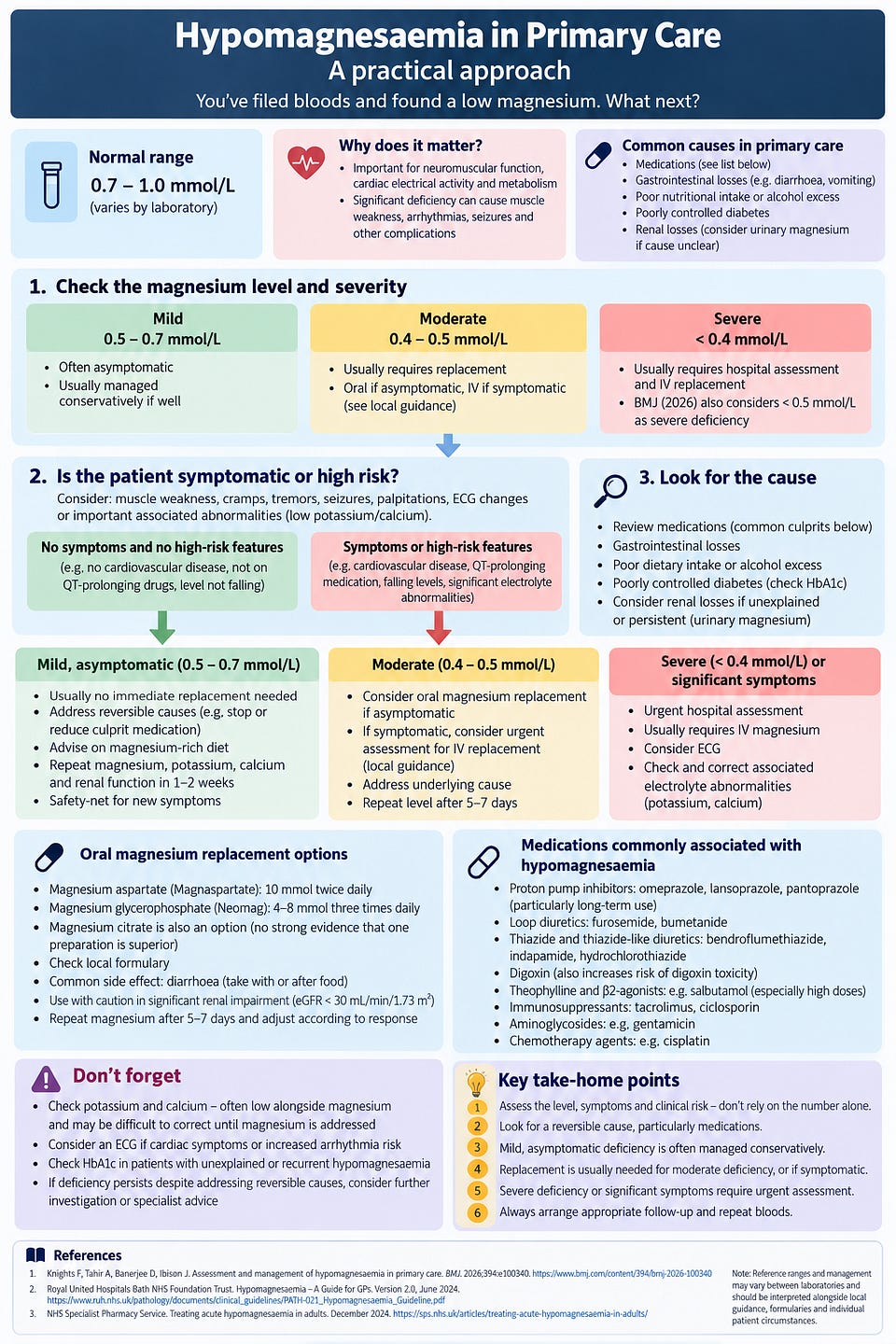
It’s low, but not dramatically so. What do you actually need to do about it? A recent article in the BMJ (September 2026) provides a useful evidence-based approach to managing hypomagnesaemia in primary care. Let’s put that into practice.
The Case: Meet David
David is 64 years old and has hypertension and gastro-oesophageal reflux disease. He takes amlodipine 5 mg OD and omeprazole 20 mg OD, which he’s been taking for several years.
His recent blood tests show:
- Magnesium: 0.58 mmol/L (normal 0.7–1.0)
- Potassium: 4.2 mmol/L (normal 3.5–5.0)
- Adjusted calcium: 2.31 mmol/L (normal 2.2–2.6)
- eGFR: 78 mL/min/1.73 m²
There are no previous magnesium results available. You telephone David and find that he’s feeling well, with no weakness, muscle cramps, palpitations or recent gastrointestinal symptoms.
…. How Low Is Too Low?
The Royal United Hospitals Bath guideline divides hypomagnesaemia into three categories:
- Mild (0.5–0.7 mmol/L): Often managed conservatively if asymptomatic.
- Moderate (0.4–0.5 mmol/L): Usually requires replacement, with the route depending on symptoms.
- Severe (below 0.4 mmol/L): Usually requires hospital assessment and IV replacement.
The recent BMJ article uses a threshold below 0.5 mmol/L for severe deficiency, highlighting some variation between guidelines. However, the number alone shouldn’t determine management....
Symptoms, cardiac risk, associated electrolyte abnormalities and the trend are equally important.
Before Prescribing, Ask Why It’s Low
In David’s case, there’s an obvious potential culprit: omeprazole. Medication-related hypomagnesaemia is particularly relevant in primary care, especially in patients taking several long-term medicines.
Drugs worth looking out for include:
- Proton pump inhibitors: Omeprazole, lansoprazole and pantoprazole, particularly with prolonged use.
- Loop diuretics: Furosemide and bumetanide.
- Thiazide and thiazide-like diuretics: Bendroflumethiazide, indapamide and hydrochlorothiazide.
- Digoxin: Associated with magnesium depletion, which can also increase the risk of digoxin toxicity.
- Theophylline and salbutamol: Can contribute to magnesium redistribution, particularly with higher doses or acute treatment.
- Specialist medications: Tacrolimus, ciclosporin, aminoglycosides such as gentamicin, and certain chemotherapy agents including cisplatin.

Other causes include gastrointestinal losses, alcohol excess, poor nutritional intake and poorly controlled diabetes. Try and cover these in your history.
For David, we’d review whether he still needs omeprazole, consider stepping down or discontinuing it where appropriate, and assess his diet and other medications. An interesting addition from the BMJ article is to also check HbA1c in patients with unexplained or recurrent hypomagnesaemia.
Does David Actually Need Magnesium Replacement?
No, as according to guidance there is limited evidence that treating mild, asymptomatic hypomagnesaemia improves clinical outcomes.
For a well patient with magnesium between 0.5 and 0.7 mmol/L, conservative management is often reasonable. However, replacement may be more appropriate if levels are falling, the patient has cardiovascular disease, is taking QT-prolonging medication or has ongoing magnesium losses.
For David, we’d review his omeprazole, encourage magnesium-rich foods such as nuts, legumes and leafy vegetables, and repeat magnesium, potassium, calcium and renal function in 1–2 weeks.
We’d also provide safety-netting advice for new weakness, tremors or palpitations.
When Should We Prescribe Magnesium?
For symptomatic mild deficiency or asymptomatic moderate deficiency, oral magnesium is generally appropriate if the patient is clinically stable.
The RUH guideline suggests:
- Magnesium aspartate (Magnaspartate): 10 mmol twice daily.
- Magnesium glycerophosphate (Neomag): 4–8 mmol three times daily.
Always remember to counsel patients on side effects as oral magnesium commonly causes diarrhoea, and patients with significant renal impairment require particular caution.
So do we need to follow up? Guidance states that if replacement is started, repeat magnesium after approximately 5–7 days, adjusting treatment according to the response.
Oh.. and remember to check potassium and calcium too. Both can be low alongside magnesium, and may be difficult to correct until magnesium deficiency is addressed.
When Should We Be Worried?
Patients with severe deficiency, significant muscle weakness, seizures, arrhythmias or important associated electrolyte disturbances require urgent assessment.
Consider an ECG where there are cardiac symptoms or increased arrhythmia risk.
The RUH guideline generally recommends hospital assessment for symptomatic moderate deficiency or magnesium below 0.4 mmol/L. Clinical judgement remains essential, particularly for patients with levels below 0.5 mmol/L.
So the next time you encounter a low magnesium result, ask yourself: Is the patient well? What’s causing it? Does it need replacing? And when should I repeat the bloods?
David’s magnesium of 0.58 mmol/L doesn’t automatically warrant a prescription or hospital referral. However, it does warrant a medication review, an assessment for reversible causes and a clear follow-up plan.
Originally published on Substack.