Pharmacy First: Five New Conditions
Announcing our NEW webinar series
Pharmacy First is about to get bigger. But perhaps more importantly, it is about to get more clinical.
Since its launch in January 2024, Pharmacy First has changed the way patients access care for a range of common conditions.
Patients can walk into a participating community pharmacy and receive assessment, advice and, where appropriate, treatment without first needing a GP appointment. It has meant less UTI, impetigo and sinusitis presentations and this has allowed primary care and other acute services to focus on the more complicated presentations.
Now, almost two years on, the service is entering its next phase.
From autumn 2026, Pharmacy First is expanding to include five new prescribing pathways:
- Low-frequency episodic migraine in adults
- Seasonal allergic rhinitis in children
- Acute otitis externa in adults
- Mild-to-moderate acne in young people and adults
- Mild skin and soft-tissue infections and scabies
This takes Pharmacy First beyond its original seven clinical pathways and represents a significant expansion in the range of conditions that can potentially be assessed and treated in community pharmacy.
Why is Pharmacy First expanding?
The rationale is fairly straightforward: primary care is under enormous pressure.
General practice continues to manage huge volumes of patients, many of whom present with common, relatively low-acuity conditions that do not necessarily require a GP or other traditional prescriber.
The original Pharmacy First model was designed partly around this problem, allowing appropriately trained pharmacists to manage suitable presentations closer to the patient’s home and freeing GP capacity for patients with more complex needs.
The model has clearly gained traction.
In its first 12 months, more than 2.2 million Pharmacy First clinical pathway consultations were recorded across England, delivered through more than 11,000 pharmacies. (MedRxiv)
And the service has continued to grow. Between March 2025 and February 2026, more than 3.3 million Pharmacy First consultations were delivered .. a 43% increase on the previous 12 months. Importantly, 86% of people using the service reported a positive experience. (GOV.UK)
This is not simply about shifting work away from general practice. It demonstrates that there is a genuine appetite for accessible, community-based clinical care.
But what have we learned from the first phase?
The early experience has been encouraging, but Pharmacy First is not without its challenges.
The service has had to contend with variable levels of awareness, differences in pharmacy activity and questions around how patients are selected and referred.
Healthwatch research found that, despite very high pharmacy participation, awareness amongst the public remained an issue. Around 29% of people who said they were unlikely to use a pharmacy for the relevant conditions were unaware that pharmacies could provide treatment and advice for them. Privacy was another concern, with 8% reporting that they felt uncomfortable discussing health concerns in the pharmacy environment. (Healthwatch)

There is also an important clinical lesson here
A Pharmacy First consultation is still a clinical consultation.
The pharmacist needs to establish the presenting complaint, take an appropriate history, identify red flags, assess risk, decide whether the patient fits the pathway, determine appropriate treatment and provide safety-netting.
NHS England’s own clinical audit guidance highlights these elements: pharmacists are expected to assess the patient, screen for red flags and risk of deterioration, decide on treatment and provide safety-netting advice. (NHS England)
That is a considerable clinical skill set and it carries risk.
From following a PGD to making a prescribing decision
And this is where the latest expansion becomes particularly interesting.
The original Pharmacy First clinical pathways were largely built around defined clinical pathways and Patient Group Directions (PGDs).
That provides an important safety framework. The pharmacist works within clearly defined inclusion and exclusion criteria and can supply specific medicines where the patient meets the requirements.
But the new model introduces something different.
From autumn 2026, independent prescribing will be incorporated into the national community pharmacy contractual framework.
A pharmacist who is an independent prescriber will be able to prescribe within existing Pharmacy First pathways and deliver the five new prescribing-only pathways. (Community Pharmacy England)
This is a significant change in mindset.
Under a PGD, the question is often:
“Does this patient meet the criteria?”
As an independent prescriber, the question becomes:
“What does this patient need?”
That requires greater clinical discretion.
The pharmacist needs to be able to recognise when a presentation does not fit the pathway, consider differential diagnoses, identify red flags, understand when treatment is inappropriate, consider interactions and contraindications, and know when the right decision is not to prescribe.
That distinction matters.
The move towards prescribing should not simply mean giving pharmacists a bigger list of medicines. It means giving appropriately trained pharmacists greater clinical responsibility.
The pharmacist’s consultation skills matter more than ever
This is also why the evolution of the pharmacy role needs to be accompanied by continued investment in clinical education.
Pharmacists already have a strong foundation in medicines, therapeutics and minor illness. The profession also has considerable experience in patient-facing consultations.
The training journey has changed significantly too.
From September 2026, all newly qualified pharmacists will enter the GPhC register as independent prescribers, following the move to prescribing education as part of the initial pharmacist training pathway. (NHS England)
That is a major development for the profession but prescribing competence is not simply about knowing which medicine to select.
It is also about history taking, clinical reasoning, examination where appropriate, risk assessment, shared decision-making, documentation and safety-netting.
These are skills that become increasingly important as community pharmacists move from a protocol-led model towards a genuinely autonomous clinical role.

NHS England’s commissioning guidance describes prescribing-based community pharmacy services as part of a wider move towards more accessible, sustainable and integrated primary care. It also emphasises the need for clear pathways, escalation arrangements, documentation, training, competency, governance and audit. (NHS England)
That is exactly what the profession should be aiming for.
Community pharmacy has an enormous opportunity to become an even more important part of the NHS clinical workforce but with greater autonomy comes greater responsibility.
The next phase of Pharmacy First therefore needs to be about more than simply increasing the number of conditions pharmacists can treat.
It needs to be about building confidence in clinical assessment and decision-making.
Supporting pharmacists through the next phase
At Pareto Education, we have launched a new series of free, practical CPD webinars specifically for community pharmacists.
FREE CPD @ 7 – Community Pharmacy Series
- 17 September – Better History Taking for Pharmacists
- 24 September – Rashes Made Simple for Pharmacists
- 1 October – Migraine Assessment for Pharmacists
- 8 October – Beyond the Prescription for Pharmacists
Each session is 45 minutes, delivered live on Microsoft Teams at 7pm.
FREE to attend | Self-CPD certificate included
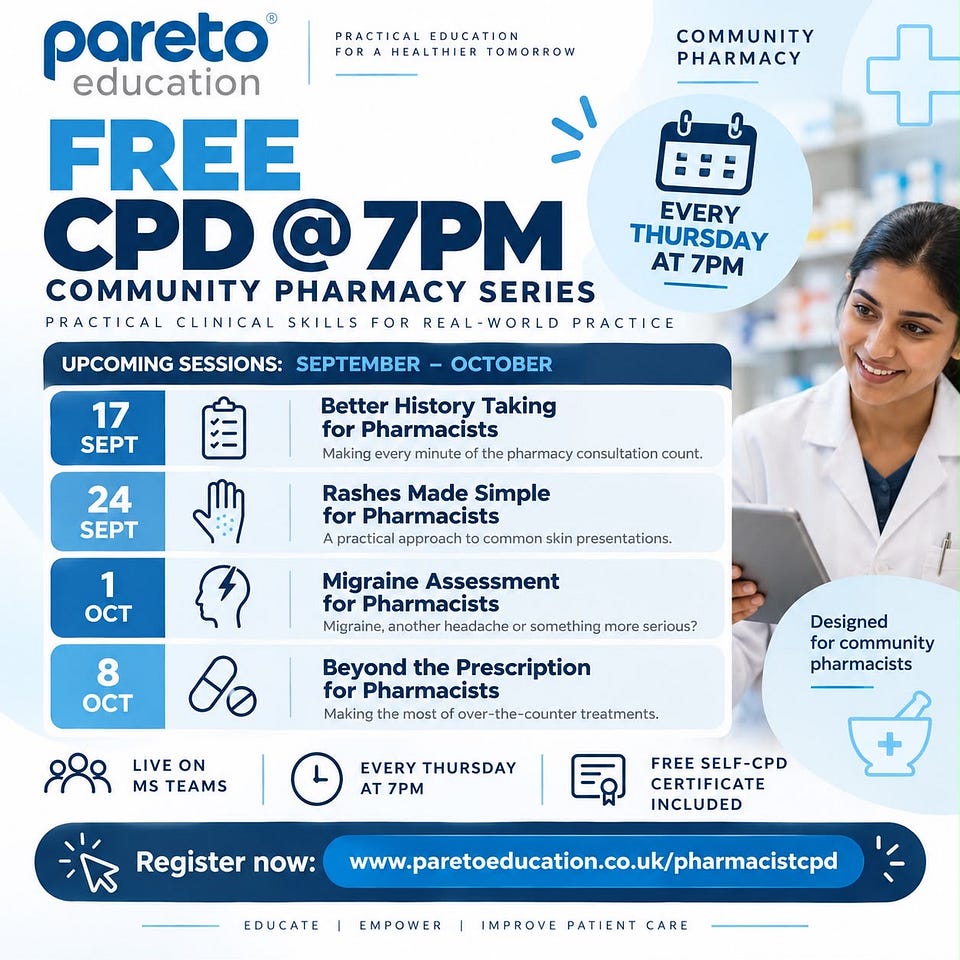
The aim is simple: practical clinical education that helps pharmacists feel more confident in the consultation, particularly as Pharmacy First moves towards a more prescribing-led model.
[Register via Pareto Education](http://www.paretoeducation.co.uk/pharmacistcpd)
Originally published on Substack.