
36-Year-Old Requesting a FIT Test
Don't Miss our Respiratory Masterclass!
Over the weekend we had a fantastic urgent care masterclass with some great interaction, questions and insights from a range of clinicians. Interestingly, we had a discussion about FIT tests which came a few days after an interesting case I assessed in general practice.
I assessed a 36-year-old patient who came in with change in bowel habit and a bit of rectal bleeding. It’s mild, and there’s a clear explanation. Haemorrhoids in pregnancy….
Clinically, nothing immediately alarming. No bleeding, no ulcers, no mucus on the stool… nothing. But there’s a twist: a friend has recently been diagnosed with colorectal cancer, and understandably, she’s worried. She has two children and she’s concerned for herself. In the end, she explicitly asks for a FIT test.
I did it… I ordered a FIT test
I tried to convince her that her changes were really low. She had a clear cause for her symptoms and it became clear that she never really had “normal” bowel habits. However, she pushed. She had her child with her and I thought “I guess there’s nothing to lose.”
I’m not sure if that was the right way to look at it. That’s me being quite honest. However, the effectiveness of the FIT test as well as the ease of access does make the decision to order a test much simpler…
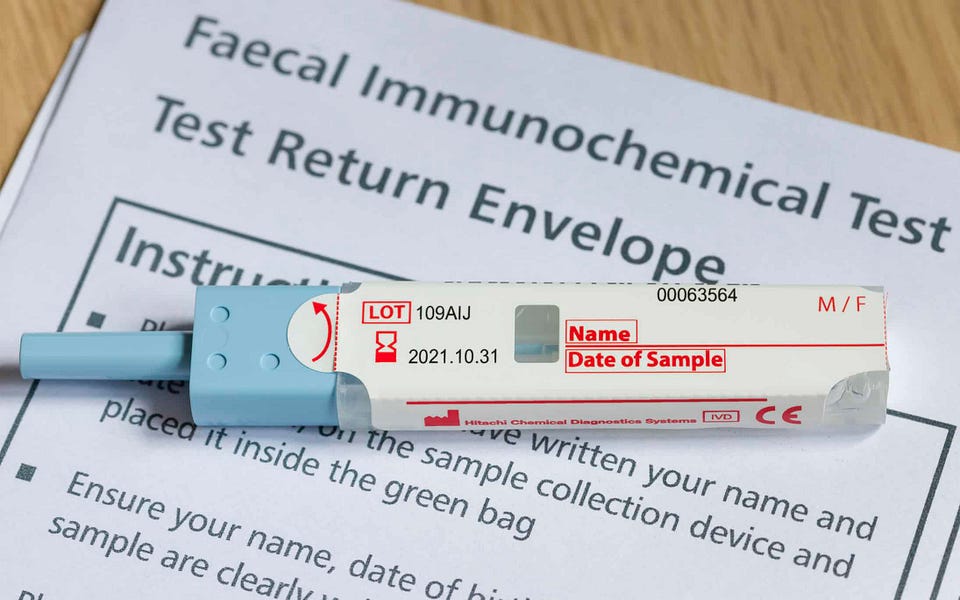
So what is a FIT test?
The faecal immunochemical test, or FIT, has become a central part of how we assess lower GI symptoms. It’s a stool test that detects tiny amounts of human blood that wouldn’t be visible otherwise. Importantly, it’s not a diagnostic test for cancer, it’s a triage tool. In other words, it helps us decide who needs further investigation, usually a colonoscopy.
What’s made FIT so popular is how good it is at ruling out colorectal cancer.
At the commonly used threshold of 10 µg of haemoglobin per gram of stool, the sensitivity is very high approximately mid-to-high 90s percent. So if the test is negative, the chance of colorectal cancer is extremely low (though not zero). On the flip side, it’s not perfectly specific. A positive result doesn’t mean cancer it could just as easily reflect bleeding from haemorrhoids or inflammation.
NICE guidance has evolved quite a bit in recent years. FIT is now recommended for most patients with lower GI symptoms where colorectal cancer is a possibility.
Where colorectal cancer is a possibility… that’s the operative phrase.
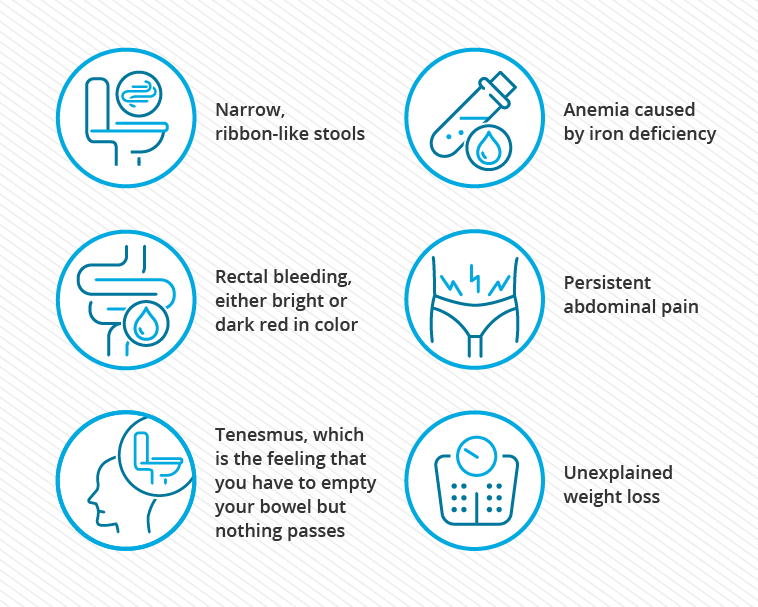
Currently it includes people with change in bowel habit, abdominal pain, weight loss, or iron deficiency anaemia. Even in patients with rectal bleeding, FIT can still be used something that would have felt counterintuitive not long ago. It’s important to note here that there is no age limit attached to this. This is why it because harder to refuse FIT requests in patients.
But that doesn’t mean every patient needs one.
Coming back to our 36-year-old: she’s young, which lowers her baseline risk. Her bleeding has a plausible explanation, and there are no red flag features like weight loss or anaemia. You could reasonably argue that this is a benign presentation and manage it conservatively without a FIT. On the other hand, she does have a change in bowel habit, and there’s a degree of uncertainty + a lot of anxiety driving the consultation.
This is where clinical judgement comes in. FIT is not strictly required here, but it would be entirely reasonable to offer it. It can provide reassurance if negative and helps formalise risk if positive. Increasingly, many clinicians are leaning towards a lower threshold for using FIT in exactly this kind of grey-area presentation.
The question of age is interesting too. We often associate colorectal cancer with older adults, but rates in younger patients are rising. NICE doesn’t exclude younger patients from FIT testing, and it can be used in under-40s if symptoms warrant it. That said, the evidence base is stronger in older populations, so results always need to be interpreted in context.
It’s more than likely that my patient was very anxious and she is probably well. Maybe she has IBS? That’s a valid thought. However, to even entertain this possibility one has to rule out every possible disease. Many clinicians now use FIT as an additional safety net before confidently labelling symptoms as IBS, particularly if there’s any diagnostic uncertainty. It’s not mandatory, but it can be helpful.
So where does that leave us?
FIT is a powerful tool, but like all tests, it works best when used thoughtfully. In a case like this, you don’t have to do it — but you probably wouldn’t be wrong to. The key is to avoid using it as a reflex and instead see it as part of a broader clinical picture. And whatever you decide, safety netting remains crucial. A negative FIT is reassuring, but persistent or changing symptoms should always prompt a rethink.
In many ways, FIT has made primary care both easier and more complicated. Easier, because we have a reliable way to stratify risk. More complicated, because we now have to decide when not to use it.
And that, as ever, is where the art of general practice comes in.
Looking to sharpen your respiratory skills and stay up to date with current practice?
Our CPD Asthma, COPD and Spirometry Masterclass is a dynamic 3-hour course designed to give you the confidence to diagnose, investigate and manage common (and not-so-common) respiratory conditions.
Led by Dr Shayan Khan, an experienced clinician and educator currently undertaking academic research into emerging asthma treatments, this session covers everything from spirometry and FeNO to CT interpretation, alongside the latest National Institute for Health and Care Excellence and British Thoracic Society guidance on asthma and COPD.
You’ll also explore interstitial lung disease and pulmonary fibrosis in a practical, accessible way. Fully CPD accredited with recorded access available, this is a high-yield course you can revisit anytime, perfect for busy clinicians wanting to build real-world confidence.
Date - Sunday 12th April 2026 - 10am - 1pm (recorded access available)
Have You Watched Our Latest History Taking Videos?
Over the years we have created a huge selection of videos for clinicians - both students and qualified professionals. Our latest selection of videos is on gynaecology and mental health histories with our latest video on anxiety. This video acts as a brilliant reference for clinicians reminding them of the key questions, red flags and principles in management.
You can watch here:
Website: www.paretoeducation.co.uk
Instagram: www.instagram.com/pareto_ed
Twitter: www.twitter.com/pareto_ed
Youtube: https://bit.ly/3DPm23c
Email: info@paretoeducation.co.uk
Originally published on Substack.


