
A 25 year old with an Aortic Dissection…?!?
Are You Attending our Clinical Emergencies Masterclass
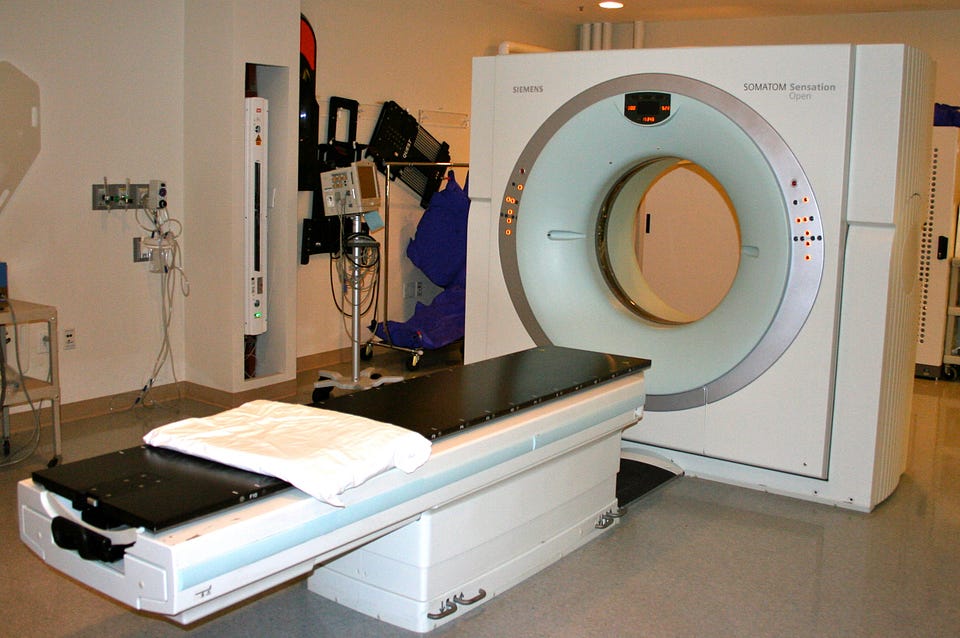
For those of you who might not be aware, my career tends to be split between general practice and A&E.
As well as enjoying the thrill of resus, working in SDEC is also very interesting. As the referrals are primarily via GP, my experience allows me to assess patients and provide a good management plan that GPs can take on post discharge.
So, it was a chilly morning and I had started my shift on SDEC. I assessed a patient with gastritis, non-cardiac chest pain and abdominal pain with no clear cause. This is quite typical on SDEC.
I then proceed to see a 25 year old female who came in with her grandad. She presented with lower and mid back pain which started spontaneously in the middle of the night. She was uncomfortable. Not to be sinister but I checked whether she had presented to A&E before (repeat presenter) but this was her first time since the birth of her baby 3 years ago.
She described the pain being sharp but has been constipated for the past few days. She kept saying that the pain “went around her body.” She had no significant history but didn’t have the greatest lifestyle habits. She smoked excessively, ate sporadically and did minimal exercise. My GP mindset always tells me to look beyond the acute presentation..
I examined her - her chest was clear. Her observations were fine apart from her HR. She was persistently tachycardic. Her blood pressure was also high. She was quite slim and slender and I did think a high blood pressure was suspicious but I can’t blame her as she was sat in pain and in a hospital. Her abdomen was soft and non tender.
Was she simply constipated? My plan was to await her bloods, do an ECG and an abdominal XR.
So what did the results show?
Her bloods were fine. FBC, U&Es and LFTs. No abnormality at all. Her ECG showed sinus tachycardia but nothing else. As for her abdominal XR, she did have some faecal loading but that was all. I did think though - “can constipation cause this much pain?”
She kept saying the pain was in her back and said it was between her shoulder blades. I didn’t do a bilateral blood pressure at the time but I didn’t think whether dissection was a possibility.
But she’s only 25!?!
Granted, she had some problematic lifestyle risk factors but she was only young. Anyway I went with my gut and spoke to the radiologist.
“Hello, is this the duty radiologist?”
“Yes it is, how can I help?”
So I gave her the details. I’m sure she was perplexed at first but she acknowledged that sometimes we have to go with our cut. Hence a CT angiogram was requested.
I gave her some codeine. Thought I should as she was in pain. It took some time for us to get her scanned and during this time I felt that it would probably be normal. The most important thing is that the patient is safe and my conscious is clear!
“Mo, your patients scan is back.” A nurse said
“It’s probably normal” is what I thought
I opened the scan and looked at the report.
Conclusion: there is a stable braciocephalic artery dissection with no extension into the aortic arch.
“She has a dissection?!?!?” Is what I thought. WOW. She’s 25 years old. My colleagues couldn’t believe it either. Ultimately she needed discussion with cardiothoracics but she was in SDEC - the ambulatory area of A&E.
I organised her transfer to the high dependency unit and handed over the case to my colleague. What happened next was a tale for the next day as my shift was over. Gosh - what a shift!
So what happened?
I came back to work the next day and no, she wasn’t still there! Don’t blame you for thinking so as it is A&E in winter after all.
She ended up being discharged home. It turned out that the finding spotted by the radiologist was an artefact. There was a huge discussion between various radiologists, cardiothoracics and vascular surgery and it was deemed that the appearances were in keeping with an artefact.
“Phew..” I thought. It only takes a case like this to change practice and we could have found ourselves organising CT angios for anyone with chest pain.
Whilst the case was a bit of an anti-climax, I felt it was a good case. It made me understand the true value of a history, asking questions in multiple ways and leaving aside assumptions and biases. I was happy for the patient as well as myself as I acted on my gut throughout this case.
Would be great to hear about any interesting cases you’ve seen? It doesn’t matter if it didn’t quite turn out the way you thought it might - the diagnostic reasoning is what counts!
CPD Clinical Education Masterclass (25/1/26)
Medical and surgical emergencies can happen anywhere and staying up to date with the latest practice is vital for clinicians.
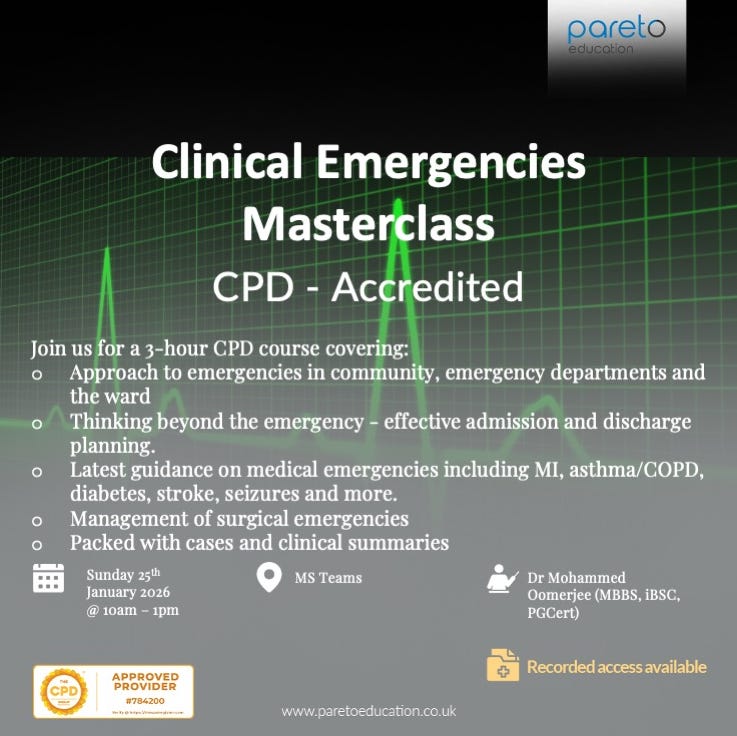
If you’re looking to learn and refresh your knowledge about the key medical and surgical emergencies, this is the course for you!
Join us on 25th January, 10–1pm for a 3-hour CPD-accredited Clinical Emergencies course, designed to boost your confidence in diagnosing and managing acute conditions. LIVE (and recorded for future access), this interactive session is led by Dr Mohammed Oomerjee, Doctor in Emergency Medicine. The course covers a practical approach to emergencies across the community, ED, and ward, with a focus on thinking beyond the emergency and effective admission and discharge planning. Expect latest guidance on MI, asthma/COPD, diabetes, stroke, seizures and more, packed with cases and clear clinical summaries.
Chronic disease 101
Our next FREE video is on carrying out COPD reviews. It’s common and is certainly beyond an inhaler and prednisolone. We go through the key principles of the review in primary care and marry these to QoF indicators as the year end is fast approaching!
Watch now:
Website: www.paretoeducation.co.uk
Instagram: www.instagram.com/pareto_ed
Twitter: www.twitter.com/pareto_ed
Youtube: https://bit.ly/3DPm23c
Email: info@paretoeducation.co.uk
Originally published on Substack.


