
Analgesia 101
Why do we prescribe, what we prescribe?
When it comes to prescribing analgesics, clinical habits and tradition often outweigh the actual data. This is not to say that we are prescribing incorrectly — after all, we are following established protocols and guidance. However, rather than relying on the classic “that’s what we’ve always done,” we should strive to make evidence-based decisions whenever possible.
Patient safety is another important consideration. Every medication has potential side effects - yes, even paracetamol, so it is crucial that our choice of analgesia maximises therapeutic benefit while minimising harm. The reality is that many medications are prescribed despite providing minimal effect or no statistically significant impact for certain types or areas of pain.
So what is Analgesia 101? Ultimately it’s an attempt my us to answer some interesting questions, assumptions and stereotypes about medications we commonly prescribe. So here we go…
1) Is Naproxen actually any better than Ibuprofen?
I’ve always wondered this. One can be bought from your local ASDA whilst the other requires a consultation and counselling with a healthcare professional.
In origin, naproxen and ibuprofen are both non-steroidal anti-inflammatory drugs (NSAIDs), widely used for pain and inflammation. Naproxen lasts longer, with a dosing interval of 8–12 hours compared with ibuprofen’s 4–6 hours, which can be more convenient for patients with chronic conditions like arthritis. Evidence-wise there are two things to consider:
- Therapeutic effect: Moore et al., 2015,Cochrane Database of Systematic Reviews compared NSAIDs for acute pain and found that naproxen and ibuprofen provide similar pain relief at standard doses. The number needed to treat (NNT) for at least 50% pain relief over 6 hours for naproxen 500 mg was 2.7, and for ibuprofen 400 mg it was 2.5 - essentially comparable.
- Cardiovascular effects: A meta-analysis by the Coxib and traditional NSAID Trialists’ Collaboration (2013, Lancet) found that naproxen may have a slightly better cardiovascular safety profile compared to other NSAIDs, whereas ibuprofen was more strongly associated with increased cardiovascular risk at high doses. Both, however, carry gastrointestinal risks, including ulcers and bleeding, particularly with prolonged use.
In conclusion,naproxen is not inherently “stronger,” but its longer half-life and somewhat safer cardiovascular profile can make it preferable in chronic inflammatory pain. Ibuprofen, however, remains highly effective for short-term pain relief.
2) How good is codeine for back pain?
I get it. When ibuprofen, naproxen and paracetamol don’t work, where else can you go? Codeine it is!
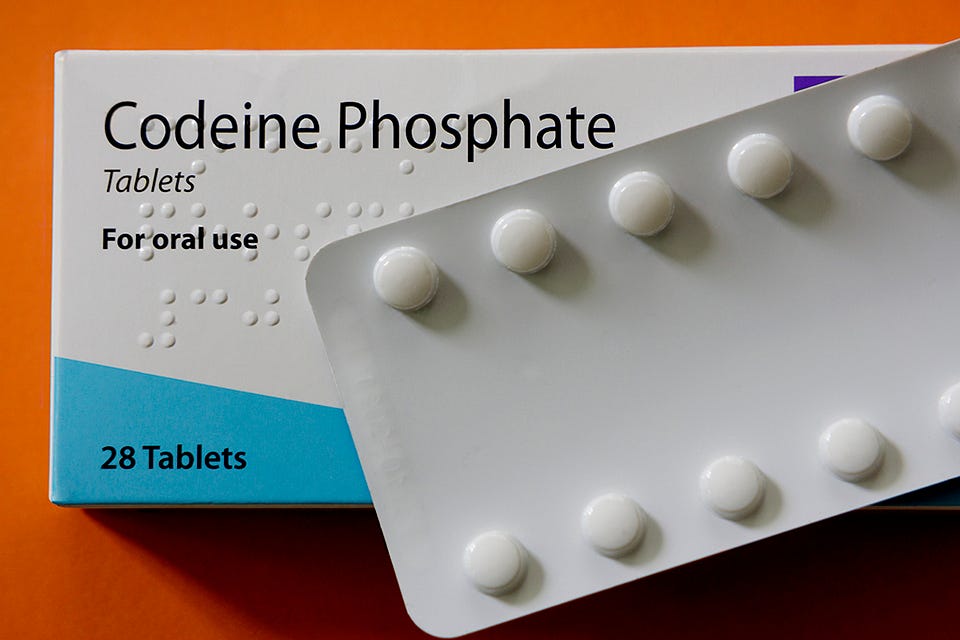
In essence, codeine is a weak opioid that requires metabolism by the CYP2D6 enzyme to morphine before exerting an analgesic effect. This process is highly variable, which explains why some patients experience little benefit while others are more sensitive to its effects. When it comes to back pain, the evidence is underwhelming. A Cochrane review (Enthoven et al., 2016, Cochrane Database of Systematic Reviews) concluded that opioids, including codeine, offered minimal benefit in low back pain and carried significant risks of side effects and dependency. NICE guidelines also recommend against using codeine for chronic low back pain.
Codeine provides limited benefit in back pain, and the risks of constipation, nausea, sedation, and dependence usually outweigh any modest analgesic effect.
3) Why is pregabalin a controlled drug in the UK?
Neuropathic medication can have all sorts of effects on patients but pregabalin has been marked as something “special.” Even before it became a Class C controlled drug I noticed that some of my patents were specifically requesting it. It was always quite peculiar.
Ultimately, the decisions to make it a controlled drug was driven by growing evidence of misuse, particularly in combination with opioids and benzodiazepines, where it significantly increases the risk of respiratory depression and overdose. Reports in the medical literature (e.g., Schifano et al., 2019, CNS Drugs) have highlighted its abuse potential, with increasing cases of dependence, diversion, and illicit use.
4) Does amitriptyline actually help with neuropathic pain?
A groundbreaking moment in modern medicine was when we discovered the phenomenon of neuropathic pain. However, despite understanding it and why it happens our attempt to develop effective medication to treat it has by and large been quite unsuccessful.
One of the first medications specifically used for neuropathic pain is Amitriptyline, a tricyclic antidepressant. It works by inhibiting serotonin and noradrenaline re-uptake, thereby enhancing descending inhibitory pain pathways. Evidence from Cochrane reviews (Moore et al., 2015, Cochrane Database of Systematic Reviews) shows that amitriptyline provides modest benefit for neuropathic pain conditions such as diabetic neuropathy and post-herpetic neuralgia. However, the effect size is small, with fewer than half of patients experiencing meaningful pain relief. Side effects including sedation, dry mouth, and weight gain which often limit its tolerability, especially at higher doses. Ultimately, we need to be realistic with regards to how much of a difference it will make to a patients pain.
5) How does tramadol work and why are we so hesitant to prescribe it?
Tramadol is often misunderstood because of its mixed pharmacology. It is a weak μ-opioid receptor agonist but also inhibits serotonin and noradrenaline reuptake, giving it antidepressant-like properties. While this dual mechanism can provide pain relief, it also introduces risks. Tramadol is associated with seizures, especially at higher doses, and has been implicated in cases of serotonin syndrome when combined with SSRIs or other serotonergic drugs (Grond & Sablotzki, 2004, Clinical Pharmacokinetics). Its metabolism, like codeine, is highly variable, which makes efficacy and side effects unpredictable. See the trend here? it’s very unpredictable and clinicians are generally risk averse people which is why 101 questions should be asked before it is prescribed (see what I did there?)
6) Is IV paracetamol actually as good as oral morphine?
When my consultant first said this I thought “what?!.”
When I had elective surgery and had IV paracetamol. This experience made me accept his view through personal experience.
As you probably know, IV paracetamol is widely used in hospitals, particularly in perioperative settings. A landmark trial (Remy et al., 2005, British Journal of Anaesthesia) suggested that 1 g IV paracetamol provided analgesia comparable to 10 mg oral morphine in acute postoperative pain. More recent systematic reviews (e.g., McNicol et al., 2016, Cochrane Database of Systematic Reviews) confirm that IV paracetamol is an effective opioid-sparing agent and generally well tolerated. Despite it being more expensive than oral morphine, IV paracetamol is safe, predictable and has excellent bioavailability. This medication will quickly establish itself as a very reliable pain relief option similar to its oral form.
I could have made this issue much longer but I feel the discussion above suffices. Pain management is very nuanced, and the best choice depends on the type of pain, patient-specific factors, and a balance between efficacy and safety. Many of the claims clinicians make about analgesia are usually down to their own experience. While some drugs have reputations that outstrip the evidence, others are underused despite strong data.
The key is to let the data - not just tradition - guide prescribing.
Until next time
Physician Associate Students - Are You Ready For Your PANE?
The PA national exam is upon us and we continue to maintain that it is one of the toughest post graduate exams in circulation. As normal, we at Pareto Education have a number of courses to help support you in your preparation. Here’s a brief preview
- PANE KBA Masterclass (Sunday 31st August 2025) - Our KBA Masterclass summarises the key information pertaining to the most commonly tested conditions within the PA National. Mapped to the new curriculum, the day is filled with lectures, summary tables and useful discussions around subject matters which are up to date according to the latest guidance. Feedback is always excellent and we will also take the opportunity to visit key exam techniques. Be sure to book on our website.
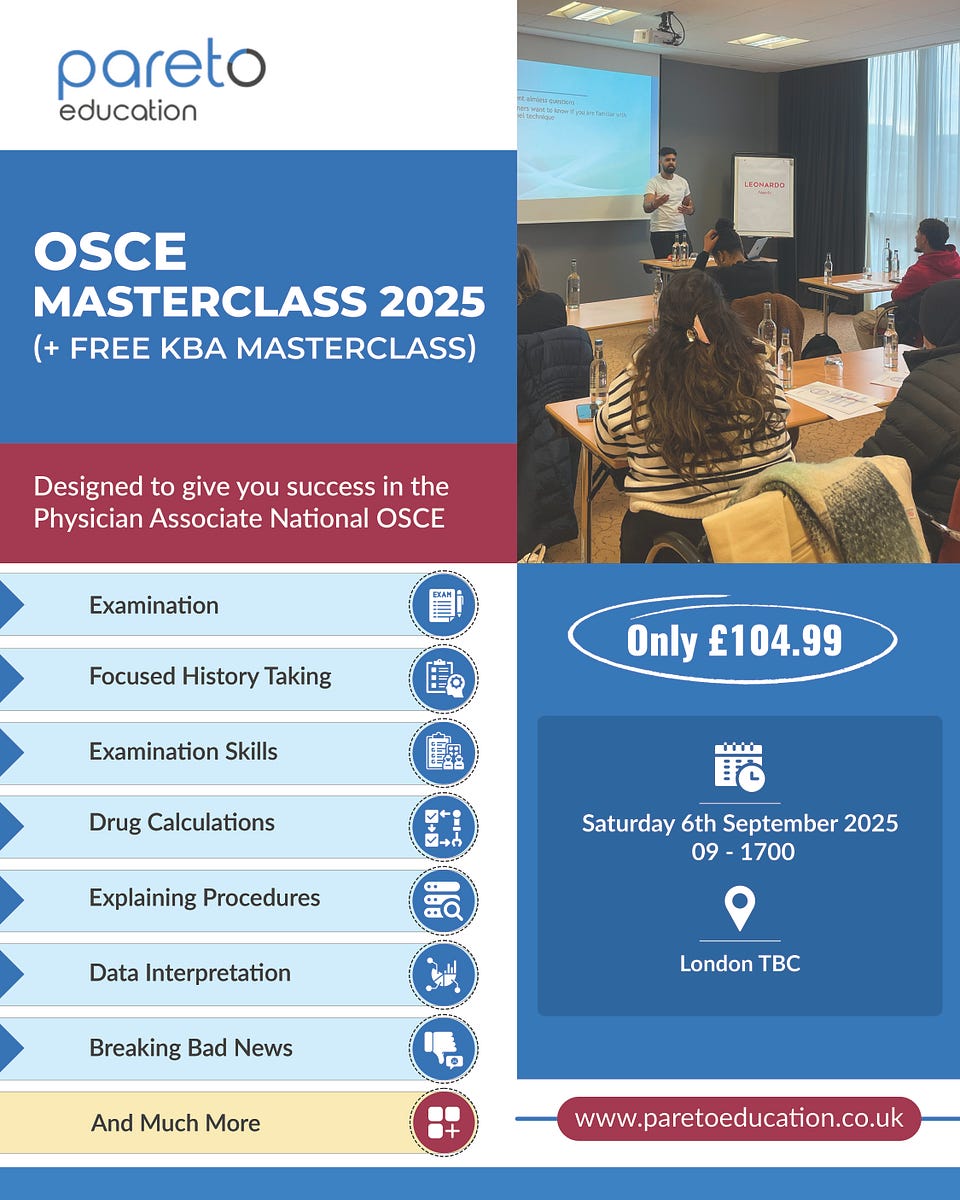
- OSCE Masterclass (F2F) in London (Saturday 6th August) - Our one-day course will comprehensively prepare you for success in the physician associate national OSCE examinations. We take the most commonly tested content in examinations and create the perfect conditions to teach, practice and learn. Our instructors are either qualified PAs or doctors who have had experience with national examinations and will be able to guide your practice and ensure your success! You can book here.
Website: www.paretoeducation.co.uk
Instagram: www.instagram.com/pareto_ed
Twitter: www.twitter.com/pareto_ed
Youtube: https://bit.ly/3DPm23c
Email: info@paretoeducation.co.uk
Originally published on Substack.


