
Falling Birth Rates: A Health Economics Perspective on a Changing World
Digging deep into my Healthcare Management BSc

One of the most valuable things I learned during my Health Management BSc was that health does not exist in isolation.
Before studying health economics and health policy, I viewed healthcare largely through a clinical lens: diagnose illness, prescribe treatment, improve outcomes. However, the degree opened my eyes to the intricate relationship between politics, economics, culture and health. It’s deep, interconnected and vital.
Public Health consultants have a good grasp of this. They work tirelessly looking at the “structural” or socio-economic determinants of health and work with a wide range of organisations. However, as a public health consultant once told me, “It does get frustrating working with government sometimes.”
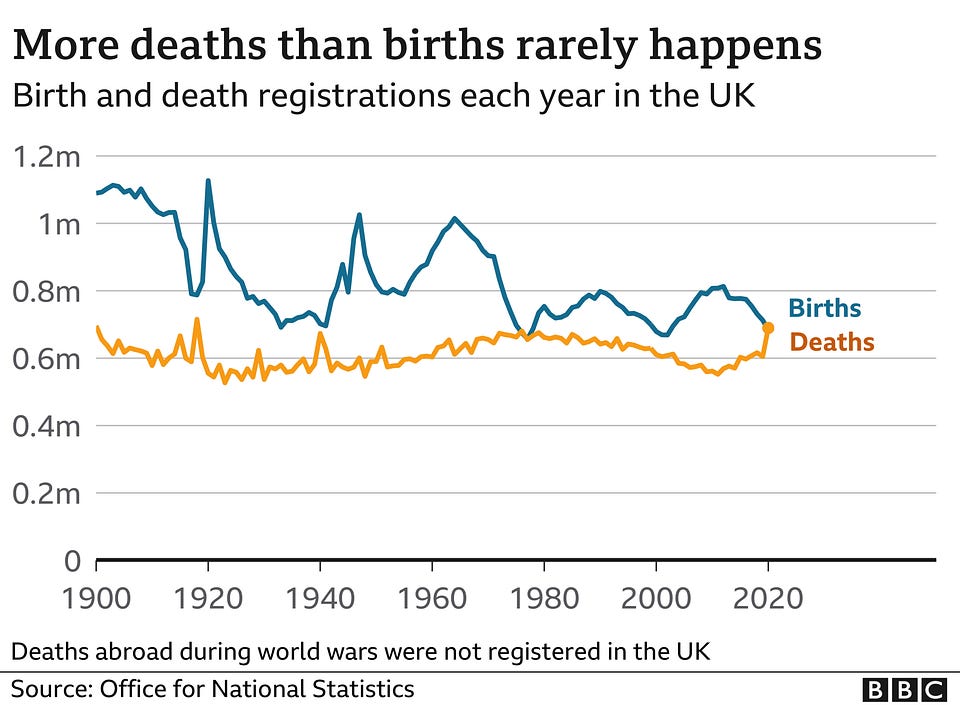
One thing on everyone’s agenda is birth rates. You may have seen some articles flying around on this issue. Recent data highlighted by the BBC demonstrates a continued decline in birth rates across the United Kingdom. This trend is not unique to Britain. It is occurring across much of Europe, East Asia and other developed economies. It’s global.
Choice is important. Some individuals choose not to have children and that is entirely understandable as personal autonomy should always be respected. However, there is an important distinction between people who do not wish to have children and those who would like to have larger families but feel unable to do so. This article explores these and despite having children myself, I can resonate.
“It’s not a nice world out there…”
“It’s expensive, children’s clubs are very pricey…”
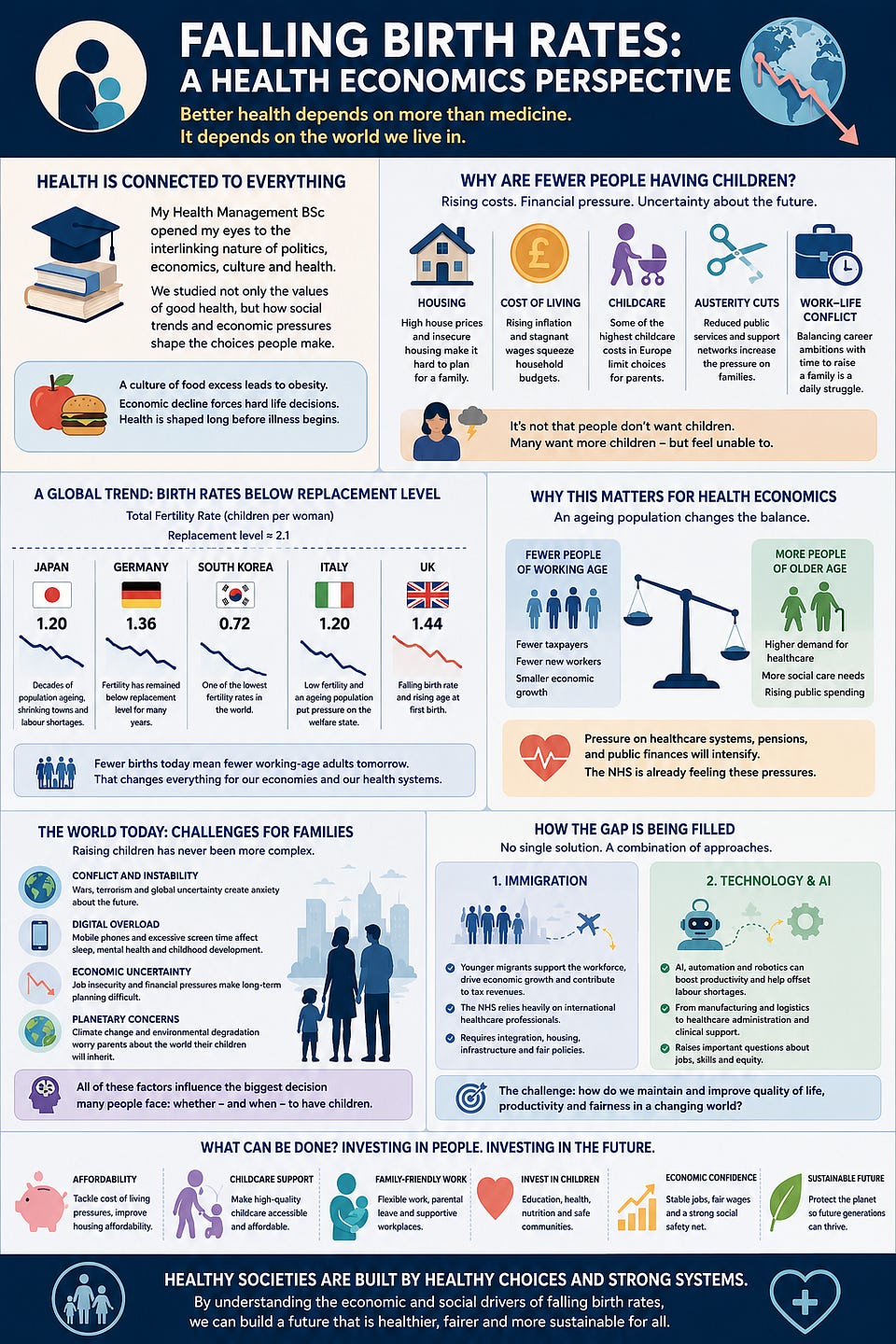
For many young adults today, the barriers are substantial. Housing costs have risen dramatically. Childcare costs remain among the highest in Europe. Inflation has eroded disposable income. Years of austerity have placed pressure on public services that families rely upon. Meanwhile, the cost of raising a child continues to increase.
The result is that many couples find themselves facing difficult trade-offs. Do they pursue career progression or spend more time with family? Can they afford to reduce working hours? Can they purchase a home large enough for a growing family? Can they access affordable childcare?
These are not purely personal questions. They are economic questions.
There are also some vital emotional/moral questions that need to be asked. We are raising families in a world that often feels less secure than previous generations experienced. Global conflicts dominate news cycles. Economic uncertainty persists. Social media and mobile phones compete relentlessly for attention. Excessive screen time has become a concern for parents, educators and healthcare professionals alike. Look how hard we have to fight to encourage our children to enjoy the outdoors towards which children are naturally inclined.
As healthcare professionals, we often discuss sustainability in terms of climate change and environmental stewardship. These issues are undeniably important. Yet there is another challenge emerging simultaneously: demographic sustainability.
The statistics are striking.
Japan has one of the world’s lowest fertility rates and has spent decades grappling with population ageing. Rural communities have shrunk, schools have closed and labour shortages have become commonplace.
Germany has faced similar challenges, with fertility rates remaining below replacement level for many years.
Italy, Spain, South Korea and numerous other developed nations are experiencing the same pattern. South Korea’s fertility rate has fallen to among the lowest ever recorded globally.
The United Kingdom is now moving in a similar direction.
Why does this matter?
I’ll try and make this as simple as possible.
From a health economics perspective, modern welfare states depend upon a balance between working-age adults and those who require support. Tax revenue generated by today’s workforce funds healthcare, pensions, social care and education.
As birth rates decline and populations age, this balance becomes increasingly difficult to maintain.
More people require healthcare and social care services. Fewer people enter the workforce to provide those services and contribute economically. This creates significant pressure on healthcare systems already struggling with workforce shortages.
The NHS is already experiencing many of these challenges.
An ageing population means greater prevalence of frailty, dementia, cancer, cardiovascular disease and multimorbidity. Demand continues to rise whilst workforce recruitment and retention remain ongoing concerns.
So how are countries responding?
Broadly speaking, there are two main solutions: immigration and technology.
Many developed nations increasingly rely on younger migrants to support economic growth, fill workforce shortages and contribute to taxation. The NHS itself is a prime example, with international healthcare professionals playing a vital role across medicine, nursing, pharmacy and allied health professions. However, immigration alone is unlikely to solve the problem and requires careful planning around housing, infrastructure and public services.
The second solution is technology. Artificial intelligence, automation and robotics are rapidly transforming industries and may help offset workforce shortages caused by ageing populations. Healthcare is no exception, with AI already supporting administration, diagnostics and clinical decision-making.
Declining birth rates are therefore more than a demographic trend—they are one of the defining health economic challenges of the twenty-first century. Their impact extends beyond healthcare, affecting pensions, social care, housing, education and economic productivity.
For healthcare professionals, these trends serve as a reminder that health is shaped by far more than disease alone. Falling birth rates reflect the intersection of economics, policy, culture and societal confidence.
The key question is not simply why fewer children are being born, but what sort of society we must create to give people confidence in the future once again.
Originally published on Substack.


