
Hepatitis C is being ‘eliminated’… but what does that actually mean?
Healthcare dictionary is an entirely different...
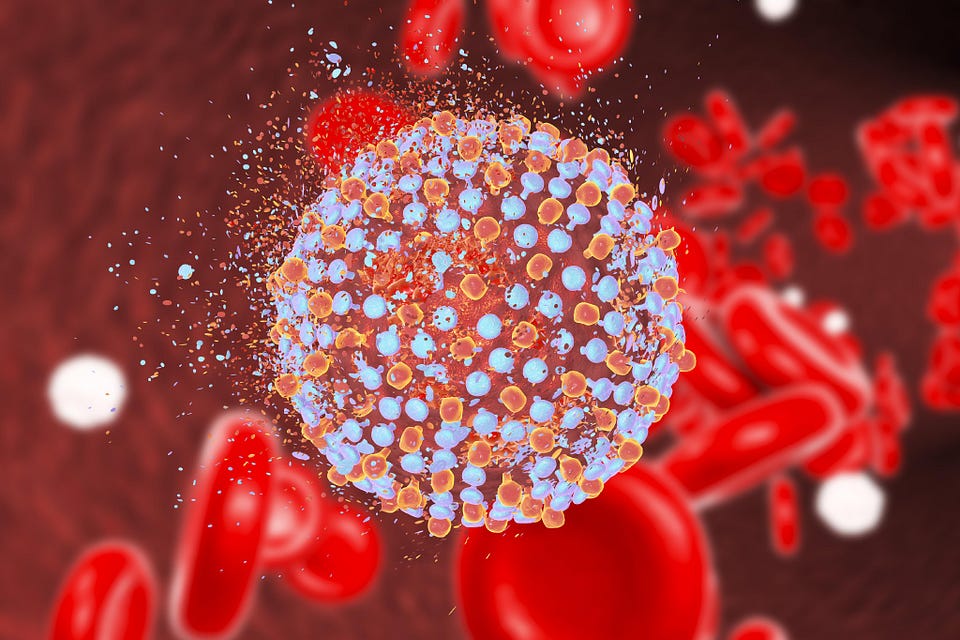
Some genuinely good news for a change.
England is reportedly on course to become one of the first countries in the world to eliminate hepatitis C as a public health threat. You can read more about this here.
That sounds enormous. But it also raises an interesting question (which led me down a rabbit hole…)
What does it actually mean to eliminate a disease?
Because, slightly confusingly, it doesn’t necessarily mean that nobody has it anymore. Grab a cup of tea and read on...
Elimination ≠ Extinction
In everyday language, if you tell someone you’ve “eliminated” something, you’d reasonably expect it to be gone. Public health likes to make things slightly more complicated. In simple terms, disease elimination generally means reducing transmission or disease burden to a defined, very low target within a particular geographical area. Cases can still occur and continued measures are usually needed to stop the disease bouncing back.
Eradication is the bigger prize and is where transmission has been permanently reduced to zero worldwide and routine interventions are no longer required.
The classic example is smallpox which was eradicated globally in 1980. In fact, smallpox remains the only human infectious disease we have ever completely eradicated.
Polio is perhaps the best example of how difficult that final step can be. Global vaccination campaigns have reduced wild polio cases by more than 99% since 1988, and two of the three types of wild poliovirus — types 2 and 3 — have been eradicated. But wild poliovirus type 1 continues to circulate, meaning we can’t quite declare victory yet.
In other words, getting from millions of cases to very few cases is one achievement. Getting from very few to zero everywhere is another challenge entirely.
So when we say England could “eliminate hepatitis C”, we’re not planning a ceremonial burning of the final hepatitis C test kit. It actually means reducing hepatitis C to the point where it is no longer a major public health threat.
And we’ve done similar things before.
Several African countries have, for example, been validated by the WHO as having eliminated trachoma as a public health problem, the infectious eye disease that can ultimately cause blindness. That doesn’t mean the organism has disappeared completely. It means disease levels have fallen below defined public health thresholds.
The same principle applies to diseases such as measles: sustained local transmission can be eliminated, while imported cases may still occur.
Elimination is therefore not the finish line. It’s more like getting a very comfortable lead and then being told you still have to keep running.
So, how close are we with hepatitis C?
Pretty close.
An estimated 50,200 adults were living with chronic hepatitis C in England in 2024, down from around 129,000 in 2015.
Among people who inject drugs (those at highest risk) prevalence fell from 28.6% in 2015 to 5.2% in 2024. England has also already exceeded the WHO target of at least 80% of diagnosed patients receiving treatment.
Alongside this, treatment has improved dramatically. Modern direct-acting antivirals can cure the vast majority of infections, often following just 8–12 weeks of tablets.
So strangely enough, one of the biggest challenges is no longer:
“Can we cure hepatitis C?”
It’s:
“Can we find everyone who has it?”
And this is where we come in...
Hepatitis C can remain asymptomatic for years, so elimination relies heavily on finding infections before they find us.
Nationally, this means initiatives such as testing in emergency departments, drug and alcohol services, prisons and community settings, alongside harm-reduction measures such as needle and syringe programmes.
But as clinicians, we have a role too.
It means remembering to consider hepatitis C testing in the right patients …particularly those with unexplained abnormal liver function tests or liver disease, a history of injecting drug use, previous exposure to potentially contaminated blood or other recognised risk factors.

It’s very easy to investigate an ALT, arrange an ultrasound and move on to the next problem. Sometimes remembering to add the hepatitis C screen is the small intervention that finds the patient who otherwise remains undiagnosed for another few years.
And that’s really how elimination happens:
Prevent transmission → find cases → treat them → keep looking.
The bigger lesson
The story of hepatitis C is a nice reminder that eliminating a disease rarely comes from one magic intervention.
Vaccination has transformed diseases such as measles and polio. Improvements in sanitation have transformed others. For hepatitis C, it’s the combination of testing, effective treatment, harm reduction and clinicians remembering who to test.
So if England does officially eliminate hepatitis C as a public health threat, there probably won’t be a dramatic moment when somebody announces:
“That’s it. Last one cured. Hep C is closed...”
There will still be testing, surveillance, prevention and treatment.
And somewhat paradoxically, the best way to keep a disease eliminated is to behave as though it could come back.
Originally published on Substack.


