
If It Isn't Documented, It Didn't Happen...
How to protect your professional license
Whether you work in primary or secondary care, we are often constrained by numerous factors outside our control. In primary care, this might mean 10-minute consultations; in secondary care, it could mean having 3–4 patients “on the go” at the same time. Our limited mental capacity can only stretch so far when trying to stay on top of all these problems.
On top of managing acute and chronic issues, making diagnoses, ordering investigations, and arranging management (including prescribing), we also have to document everything. Unfortunately, we rarely have the luxury of sitting down at the end of the day to do this — it has to be done on the go while balancing all our other clinical responsibilities.
No matter how much we may dislike it at times, documentation is the most important thing you can do to protect yourself. It is our best defence. Here’s a landmark case where that process didn’t quite go as it should have.
Toombes v Mitchell (2021)
Folic Acid in Pregnancy - fairly bread-and-butter stuff, as it’s widely publicised and most patients are aware of it.
However, in this landmark case, things went terribly wrong for the doctor involved. Here’s what happened:
Mrs Caroline Toombes attended her GP, Dr Philip Mitchell, seeking pre-conception advice. She was otherwise well but wanted guidance on how to optimise her health before trying to conceive. Mrs Toombes claimed that Dr Mitchell told her that folic acid supplements were unnecessary if she had a good diet. Dr Mitchell maintained that he would have followed standard practice by advising 400 µg folic acid daily prior to conception, but his contemporaneous notes were brief, recording only: “Generally well. No significant medical history.” There was no mention of folic acid, the risks of neural tube defects, or the content of their discussion.
Later that year, Mrs Toombes became pregnant and gave birth to her daughter, Evie, who was diagnosed with lipomyelomeningocele — a neural tube defect similar to spina bifida. Evie brought a claim under the Congenital Disabilities (Civil Liability) Act 1976, arguing that had her mother been advised correctly, she would have delayed conception, taken folic acid, and likely conceived a healthy child at a later date.
The High Court found in Evie’s favour. The judge preferred Mrs Toombes’ detailed recollection over Dr Mitchell’s account, largely because the notes lacked any record of the advice given. Without documentary evidence to support his version of events, Dr Mitchell could not demonstrate that folic acid had been discussed. The court concluded that the failure to advise constituted negligence and that this negligence had directly led to Evie’s condition.
Lessons For Clinicians
This case is considered a landmark for clinical practice in both the public and private sectors. Ultimately, courts rely on documented evidence when making a judgment, and detailed medical records play a vital role. Where notes are sparse or generic, the court may give preference to a patient’s memory (the claimant), even decades later.

I know what you’re thinking at this moment:
“No way… that really happened?” “Surely they should have considered the doctor’s view. He’s a doctor!”
I thought the same. However, the law works in a particular way, and this case will now be used as a reference for future cases. I’ve seen a lot of people writing documentation, and there are some really, really poor examples. Here are some case examples of key things we should ensure when documenting.
Example 1: Acute sore throat
Poor:
“Sore throat. Advised re analgesia.”
This tells the reader nothing about your assessment, red-flag checks, or reasoning. If the patient later develops quinsy or sepsis, there is no record to show you considered serious causes or provided safety netting.
Good:
“3-day history of sore throat, temp 38 °C, odynophagia. No dysphagia, stridor, drooling, or neck swelling. Tonsils erythematous, no exudate, no cervical lymphadenopathy. Centor score 1 – viral cause likely. Explained no antibiotics indicated. Advised paracetamol/ibuprofen, fluids, and to seek review if difficulty swallowing, breathing issues, or worsening pain. Patient verbalised understanding.”
This records history, examination, decision-making, and safety netting.
Example 2: Consent for steroid injection
Poor:
“Discussed risks and benefits. Patient agreed.”
This does not demonstrate what was actually said or that the patient was informed about alternatives.
Good:
“Discussed steroid injection for subacromial bursitis. Benefits: pain reduction, improved function. Risks: infection (<1/1000), skin depigmentation, fat atrophy, post-injection flare, transient hyperglycaemia in diabetics. Alternatives: physiotherapy, oral NSAIDs. Patient opted for injection after questions answered. Written consent obtained. Injection given aseptically.”
This specifies the risks, benefits, and alternatives, and documents the consent process clearly.
Example 3: Primary prevention with statin in high QRISK
Poor:
“High QRISK. Start atorvastatin 20 mg.”
This fails to show any discussion of risk reduction, side effects, or alternatives.
Good:
“QRISK3 21% (10 yr). Discussed atorvastatin 20 mg – reduces cardiovascular risk by ~25%. Risks: myalgia (1–5%), liver enzyme rise (<1%), very rare rhabdomyolysis. Lifestyle changes discussed: diet, exercise, smoking cessation. Patient agreed to start statin; baseline LFTs arranged, follow-up in 3/12.”
This demonstrates shared decision-making and informed consent.
Each example can be dissected further for additional learning points, but I think the above discussion suffices. Some clinicians have pre-populated templates, use software like Heidi, or keep Word documents full of safety-netting advice. Ultimately, it needs to be documented - that’s how you protect yourself in court.
Key Tips from Pareto Education
his newsletter could easily be a whole lecture (maybe we’ll run a webinar on this?), but I wanted to end with some important tips for ensuring high-quality documentation. Here we go:
Don’t overburden yourself – Whether in primary or secondary care, patient safety is paramount, and poor documentation is both a professional and patient safety issue. Therefore, if a patient presents with multiple problems in primary care, tell them that one appointment is intended for only one problem. If you’re in secondary care, such as working in AMU seeing new arrivals, be sure to take on only a manageable number of patients. We all want to help our patients and assist the wider team, but it’s important that you give each step in the patient’s journey its due attention.
Be specific – Record exactly what you advised, including the key risks, benefits, and alternatives discussed.
Document things mentioned in passing – Patients do this all the time… trust me. “Oh doctor, quick thing: my nail has been painful for a while and I’ve been taking this — is it okay?” You might answer the question immediately, but make sure to note that the patient asked about it. Ultimately, you’ve provided advice, and that advice should be recorded.
Capture reasoning – Show why you made your decision, especially if it differs from usual practice. If you don’t believe the presentation is consistent with cancer, PE, or stroke, then mention the important negatives.
Document patient understanding and choice – Note questions asked and the patient’s expressed decision. If they are going against medical advice, such as self-discharging or self-medicating contrary to advice, then record the details of the conversation. Ultimately, you don’t want the blame coming back to you.
Make records contemporaneously – Notes made at the time are far more credible in court than retrospective entries. I understand that this isn’t always possible, but try to document in real time. AI software can be helpful, but it will still require a “once-over” by you.
Remember the test – Write as if your notes will be read in 10 years by someone with no prior knowledge of the patient. Make them detailed where necessary and don’t cut corners.
Until next time!
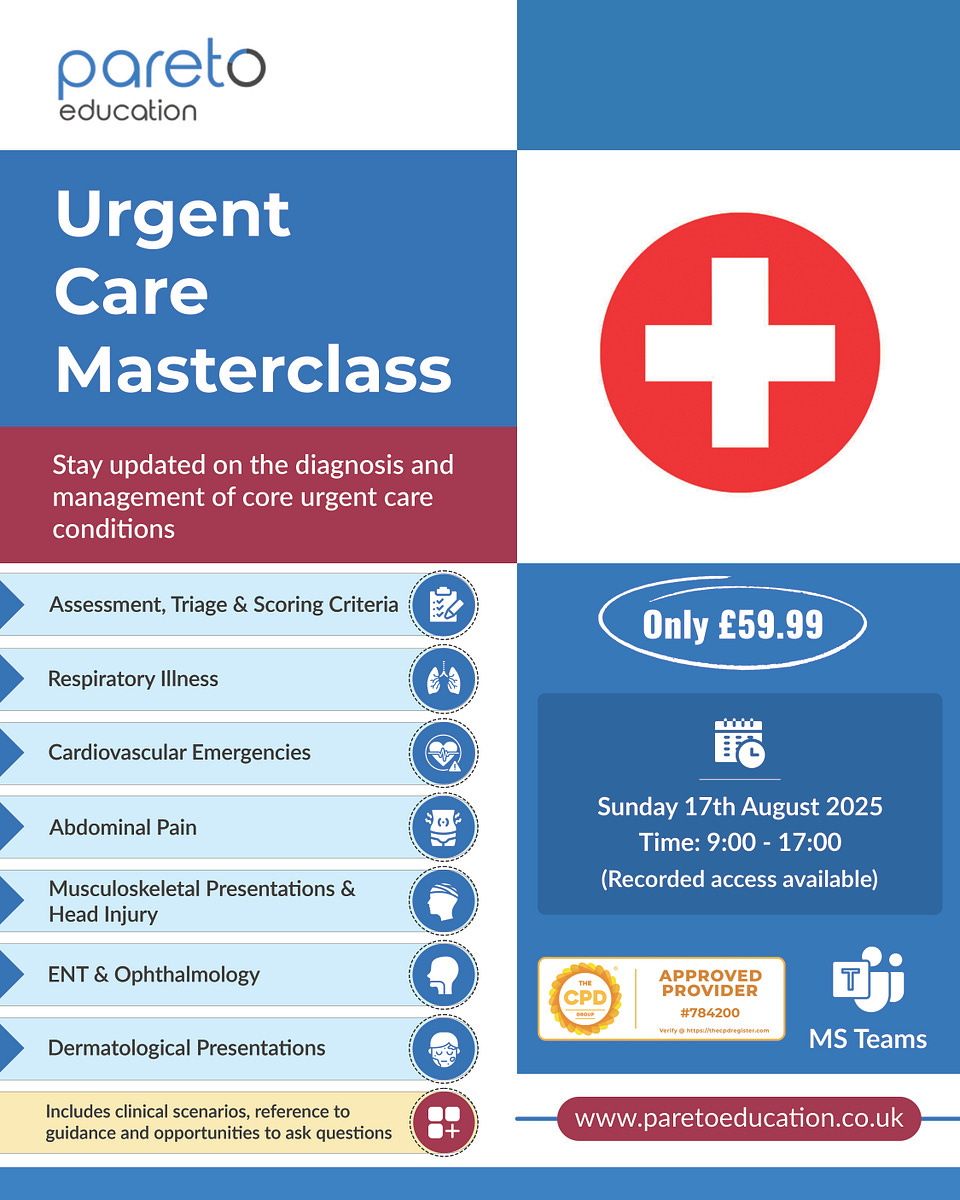
CPD Urgent Care Masterclass - Our Special Guest Speaker!
Be sure to sign up for our FINAL CPD COURSE for this season. Based on popular demand, we are proud to announce our CPD Urgent Care Masterclass where we will be covering a large number of key presentations within urgent and acute care settings!
As a bonus, we have an excellent panel of instructors including a special guest mentioned below.
- Dr Michael Leech (ACP, IP, PhD) - Michael is an experienced ACP working in urgent care. He is also an experienced lecturer at UCL in the Independent Prescribing module and holds a PHD.
- Dr Mohammed Oomerjee (MBBS) is an experienced clinician working in both primary care and accident & emergency. He is also the co-founder of Pareto Education.
- Mr Kameel Khan (MSc) is an experienced physician assistant working in gastroenterology with extensive lecturing experience.
If you're interested in reading more about the topics that are covered, be sure to visit the following link.
Website: www.paretoeducation.co.uk
Instagram: www.instagram.com/pareto_ed
Twitter: www.twitter.com/pareto_ed
Youtube: https://bit.ly/3DPm23c
Email: info@paretoeducation.co.uk
Originally published on Substack.


