
More Than Just a Normal Ejection Fraction
Why HFpEF has challenged clinicians for years and how finerenone may offer a new approach
Meet Mrs Smith. She is 76, has hypertension, type 2 diabetes and stage 3 chronic kidney disease. Over the past year she's become increasingly breathless walking to the local shops. Her legs are swollen bilaterally and she sleeps with three pillows for comfort. Her BNP was raised and her subsequent echocardiogram shows a left ventricular ejection fraction of 60%, so her heart is "pumping normally"
... yet she clearly has heart failure.
For years, patients like Mrs Smith have presented one of the biggest frustrations in cardiology. Unlike heart failure with reduced ejection fraction (HFrEF), where several treatments improve symptoms, reduce hospital admissions and prolong life, options for heart failure with preserved ejection fraction (HFpEF) have been comparatively limited.
That picture is beginning to change - trust me.
Recent advances have transformed our understanding of HFpEF from simply “heart failure with a normal ejection fraction” into a complex condition driven by inflammation, fibrosis and multiple long-term conditions. As our understanding has evolved, so too have the therapies designed to target these underlying mechanisms.
The latest development is [draft NICE guidance recommending finerenone](https://www.nice.org.uk/guidance/indevelopment/gid-ta11651) for selected patients with HFpEF. While the guidance is not yet final and finerenone is not currently included in our local formulary, it offers an opportunity to look at how heart failure management has evolved, and why this medication could become an important addition to our therapeutic toolkit in the near future.
From “Heart Failure” to Distinct Disease Phenotypes
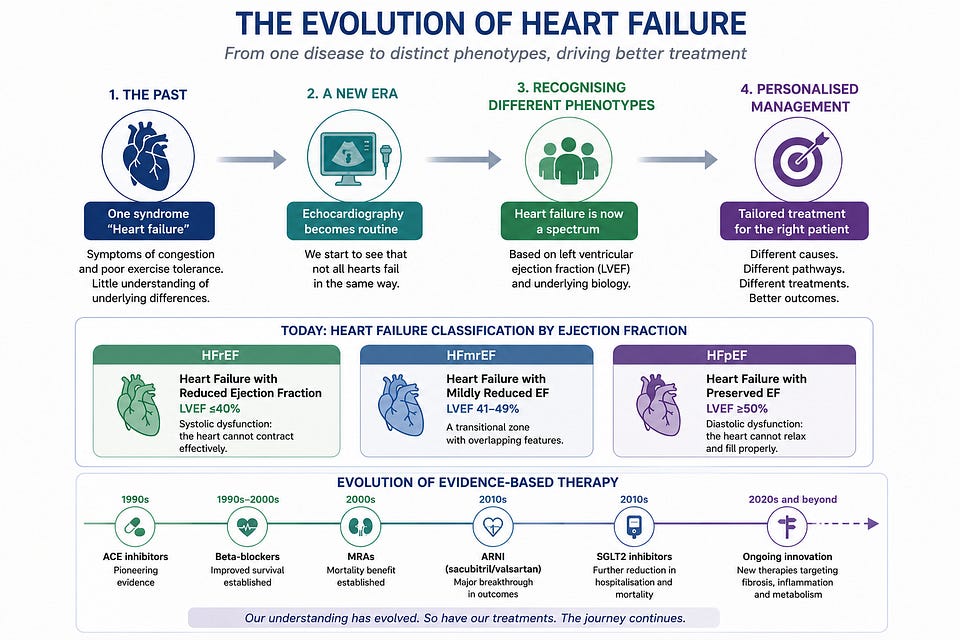
Not so long ago, heart failure was viewed as a single condition—the heart simply wasn’t pumping effectively. As echocardiography became routine, however, it became clear that not every patient with heart failure had a weak heart.
Today, heart failure is classified according to left ventricular ejection fraction (LVEF):
- Heart Failure with Reduced Ejection Fraction (HFrEF) – LVEF ≤40%, where the heart struggles to contract effectively.
- Heart Failure with Mildly Reduced Ejection Fraction (HFmrEF) – LVEF 41–49%.
- Heart Failure with Preserved Ejection Fraction (HFpEF) – LVEF ≥50%, where the heart pumps normally but has difficulty relaxing and filling.
This distinction has proved far more than academic as it reflects fundamentally different disease processes and explains why treatments that work brilliantly for HFrEF don’t always translate to HFpEF.
Why is HFpEF So Difficult to Treat?
HFpEF was once thought of simply as “heart failure with a normal ejection fraction.” We now know it’s considerably more complex.
Rather than one single disease, HFpEF is a syndrome driven by multiple interacting conditions. Most patients have a combination of:
- Hypertension
- Type 2 diabetes
- Chronic kidney disease
- Obesity
- Atrial fibrillation
- Increasing age
These conditions are thought to create a chronic inflammatory environment throughout the body. This inflammation affects the coronary microvasculature, leading to endothelial dysfunction and reduced nitric oxide signalling. The downstream effect is increased myocardial fibrosis, ventricular stiffening and impaired relaxation of the heart muscle.
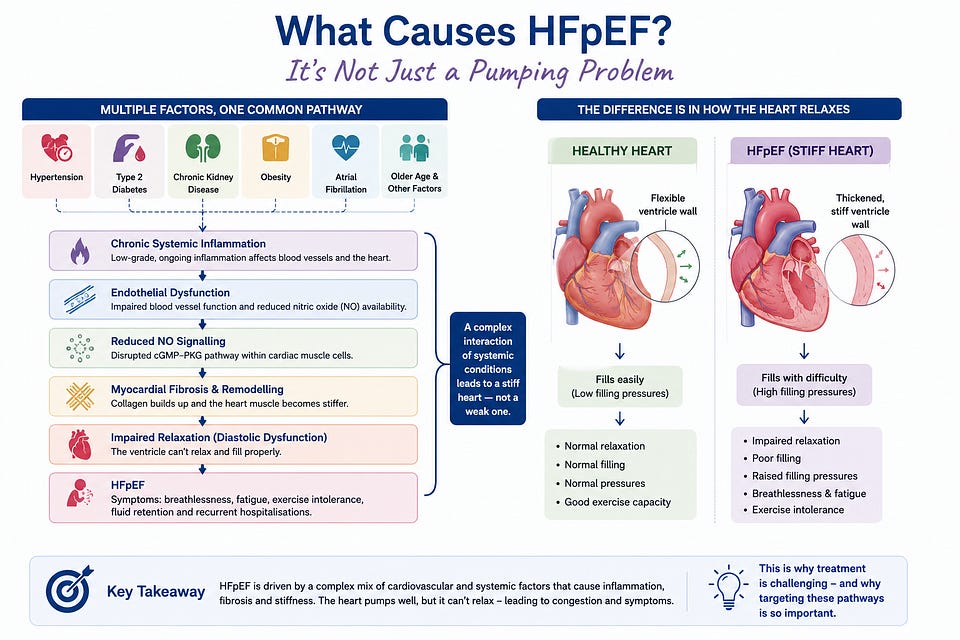
The result? The heart still squeezes well, but it doesn’t relax properly. Patients become breathless, fatigued and exercise intolerant despite having a “normal” ejection fraction.
Unlike HFrEF, where impaired systolic function is the dominant problem, HFpEF has numerous overlapping mechanisms. That complexity has made it notoriously difficult to develop effective disease-modifying treatments.
Where Are We Now?
Until relatively recently, managing HFpEF meant treating the consequences rather than the disease itself:
- Diuretics for congestion
- Blood pressure optimisation
- Managing atrial fibrillation
- Treating diabetes, obesity and other comorbidities
While these interventions remain essential, they don’t directly target the underlying disease process.
Sacubitril/Valsartan (Entresto)
One of the first therapies to show promise was sacubitril/valsartan (Entresto).

By combining neprilysin inhibition with angiotensin receptor blockade, Entresto enhances the body’s natural natriuretic peptide system while suppressing the renin-angiotensin-aldosterone system.
The PARAGON-HF trial narrowly missed statistical significance for its primary endpoint, but important subgroup analyses suggested benefit in patients with ejection fractions towards the lower end of the preserved range and in women. Subsequent pooled analyses with PARADIGM-HF strengthened the evidence base and have led to recommendations for selected patients.
Although the benefits are more modest than those seen in HFrEF, Entresto represented one of the first signs that HFpEF could be modified rather than simply managed.
Finerenone – Targeting Fibrosis
Finerenone represents a different approach altogether.
It is a non-steroidal mineralocorticoid receptor antagonist (MRA), designed to selectively block overactivation of the mineralocorticoid receptor with fewer off-target hormonal effects than traditional agents such as spironolactone.
Why is this important?
Activation of the mineralocorticoid receptor contributes to:
- Myocardial fibrosis
- Cardiac remodelling
- Inflammation
- Renal injury
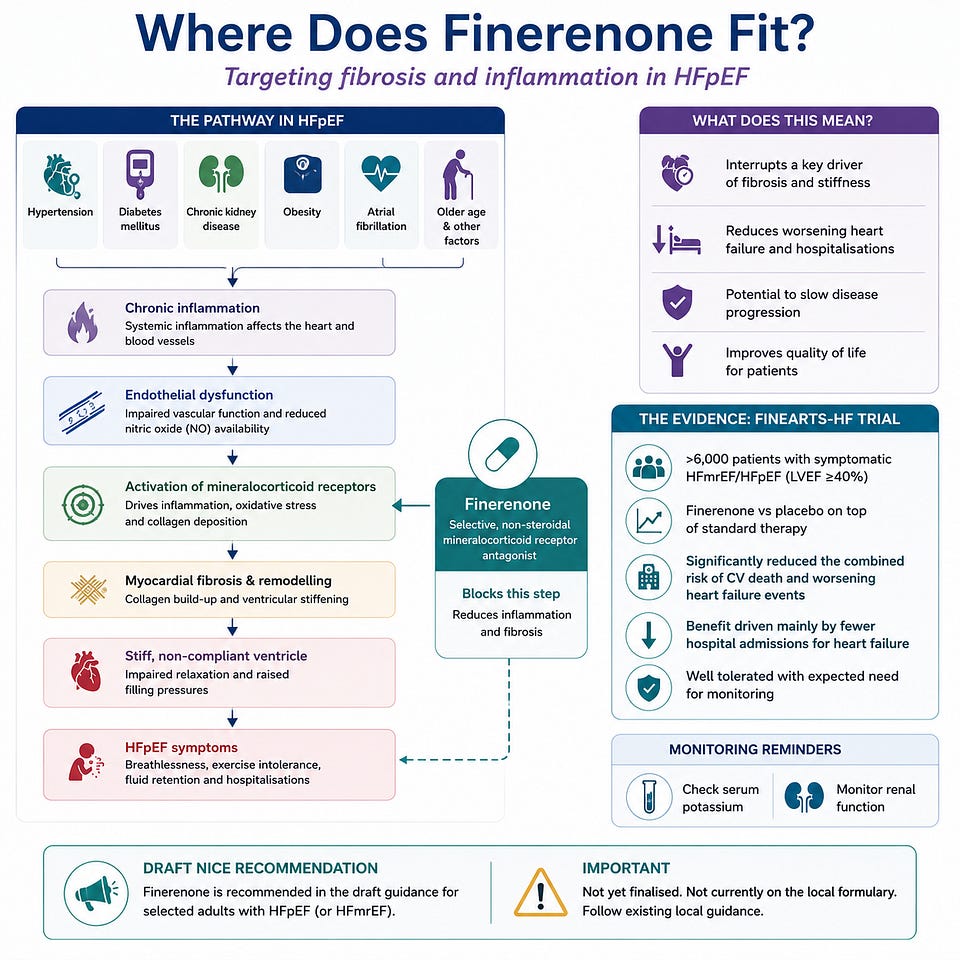
These pathways are increasingly recognised as key drivers of HFpEF. Rather than focusing solely on haemodynamics, finerenone aims to interrupt the disease process itself.
The Evidence – FINEARTS-HF
The draft NICE recommendation is based largely on the FINEARTS-HF trial (Solomon SD et al., New England Journal of Medicine, 2024), which enrolled more than 6,000 patients with symptomatic heart failure and an LVEF ≥40%.
Compared with placebo, finerenone significantly reduced the combined risk of worsening heart failure events and cardiovascular death, with much of the benefit driven by fewer hospital admissions for heart failure. Benefits were seen across a broad range of patients and the treatment was generally well tolerated, with the expected need to monitor renal function and serum potassium.
While the reduction in cardiovascular mortality alone was modest, the study provides encouraging evidence that targeting fibrosis and inflammation can improve outcomes in HFpEF, an area where effective therapies have historically been limited.
So… What Does NICE Say?
NICE has issued draft guidance recommending finerenone for selected adults with symptomatic chronic heart failure with preserved or mildly reduced ejection fraction.
It’s important to remember that this is draft guidance at this stage.
Finerenone:
- Has not yet received final NICE approval.
- Is not currently included in our local formulary.
- Will undergo the usual local formulary review and commissioning process before any implementation.
For now, clinicians should continue to follow existing local guidance. However, being aware of emerging therapies means we’re ready to adapt as the evidence and recommendations evolve.
Looking Ahead…
Heart failure management has come a long way. We’ve moved from viewing heart failure as a single disease to recognising distinct phenotypes with different underlying biology. HFrEF has benefited from decades of therapeutic breakthroughs, while HFpEF has remained one of the biggest unmet needs in cardiovascular medicine.
That gap is finally beginning to close.
SGLT2 inhibitors, sacubitril/valsartan and now finerenone all reflect a growing understanding that HFpEF isn’t simply a pumping problem—it’s a disease driven by inflammation, fibrosis and multiple long-term conditions.
Although finerenone isn’t yet part of our local formulary, keeping up to date with developments like these ensures we’re ready for the future. As the evidence grows and national guidance evolves, we’ll be well placed to recognise which patients may benefit from the next generation of heart failure therapies.
After all, today’s draft guidance could become tomorrow’s standard of care.
New YouTube Video: The NHS Is Changing Faster Than You Think
The NHS is evolving at an unprecedented pace.
From Pharmacy First and Right to Choose to AI-assisted documentation, neighbourhood healthcare teams and major structural reforms, the way we deliver care is changing rapidly.
Keeping up to date with these developments is becoming just as important as staying current with clinical evidence, helping clinicians understand not onlywhatis changing, butwhy.
If you're interested in the future of healthcare and how these reforms may shape clinical practice, this latest video provides an accessible overview of the key changes every clinician should be aware of.
Originally published on Substack.


