
So Glad I Didn't Miss This...
A potentially FATAL case in A&E (with images)
Front line care is NOT easy. I’ve worked in A&E and general practice for years as a doctor and the job does not get easier. The risk is huge, stakes are high and the potential repercussions are potentially life-ending. Yes.. it’s that morbid.
I recently came across a 57 year woman in A&E. Her triage notes read “chest pain” and I thought “hmm… this could be an interesting one.” The department was heaving with patients, many of whom were waiting several hours and a cursory look at her blood results showed that they were all normal. A “good sign” I thought.
So I picked her up. She wasn’t actually from the city, she worked here and whilst walking back to her car she had “severe chest pain.”
“Severe” always means different things to different people. Her husband told me that she never really complains of pain so for them to come to A&E must mean something serious. She told me that this chest pain was 10/10, causing her to break in a sweat. It radiated to her back and then to her abdomen. All of this lasted about 20-30 minutes until the pain started to calm down and she started to vomit ferociously. “I vomited at least 10 times” she told me.
She denied palpitations, a cough and a temperature. There was no pleuritic nature to her pain and it went as fast as it came on, leaving her with a dull ache in her chest and back. She had a history of hypertension for which she was on losartan but aside from that, she was absolutely fine.
I proceeded to examine her and found:
- On admission: HR 98, BP 178/101, RR 16, Temp 38.1
- On assessment: HR 84, BP 162/92, RR 18, Temp 36.7
- Chest clear, very slight ejection systolic murmur loudest in the aortic area.
“Has anyone told you that you have a murmur?”
“No” she replied.
Things were slightly strange. Why did her pain go from her chest to her back and then to her abdomen. Also why did she vomit so many times. She has a temperature on admission, perhaps she has some gastroenteritis? Also why does she have a murmur? All very peculiar.
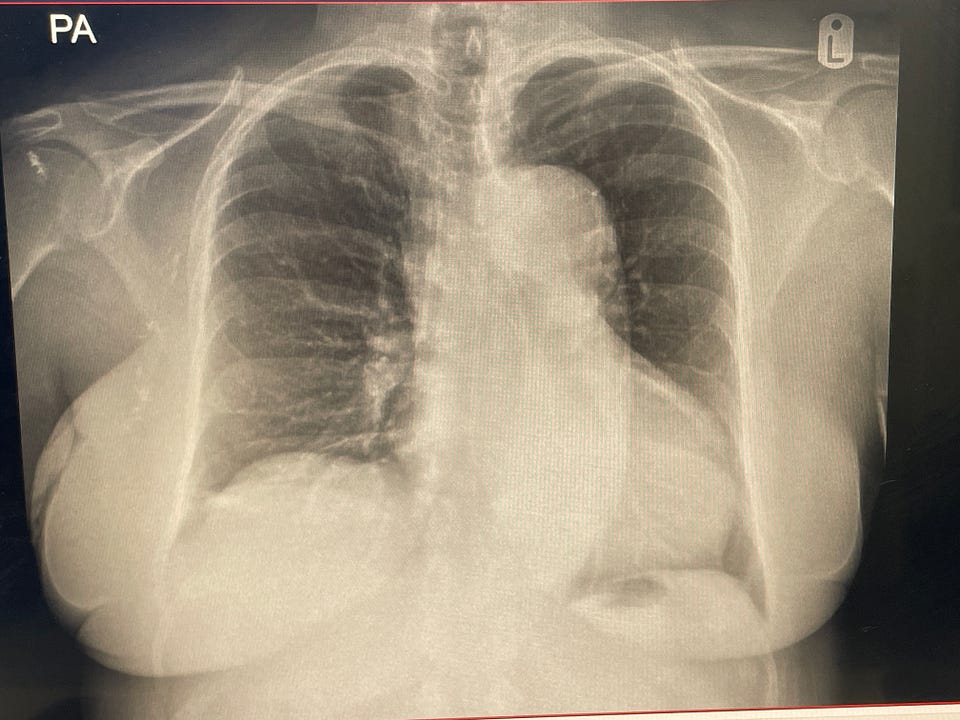
As for her bloods, her FBC, U&E and LFTs were normal. Her CRP was slightly raised at 12 and there was no troponin done. I added it on and asked her to go for an x-ray. She came back and this is what I found.
X-ray Findings
For those of you working in secondary care or currently studying, think about what you can see? Here is what I noticed
- Widened mediastinum,
- Significantly large aorta. Check out that aortic arch,
- Cardiomegaly
- ?Right sided pleural effusion
Ok.. so things got more peculiar with this x-ray. She didn’t have any previous chest x-rays to compare with and I wasn’t sure what was going on. At the time of looking at her x-ray, she was absolutely pain free. She looked completely well but I couldn't explain why her aorta was large. I had only one diagnosis in mind and that was whether she had an aortic dissection.
“Nah…” I thought. She couldn't have an aortic dissection. She looked so well! Her troponin had also come back and that was negative and I thought I’d see her ECG. I looked at her ECG and to be surprise she had NEW t-wave inversion. This just became all the more suspicious for the diagnosis I feared
“Hello…is this the duty radiologist?”
”Yes it is, how can I help?”
She was nice. I explained the case and asked her to look at the history. She explained that the x-ray could simply show an unfolded aorta. I wasn’t sure what that was at the time but I informed her that the history was slightly peculiar. “Let’s do a CT scan then” said the radiologist. So I put a request on the system and told the patient what I wanted to rule out. She looked at me with a confused look and said “You think I’ve got something that serious? I feel perfectly fine now.” I told her I just had to be sure.

I strolled back into the area of A&E I was working in and thought I’d catch up with some of the nurses about anyone they might be concerned about. The phone then rang and the nurse turned to me and said “they want to speak to you.”
“Hello..” I said
“You're patient… she has an aortic dissection.” said the HCA.
“What?!? Take her to resus as she will need urgent transfer to the tertiary centre under cardiothoracics.” I replied
Her CT scan showed a HUGE dissection, extending from the aortic root down to the level of her inferior mesenteric artery. Here’s how this explained her symptoms
- The dissection started at the root of the aorta, this is why she had a systolic murmur.
- It involved her coronary arteries, explaining the t-wave inversion.
- The pain went to her back which is in keeping with thoracic aortic dissection.
- The pain also travelled to her abdomen which is in keeping with the fact that the dissection also involved the abdominal aorta.
Here are some highlights from the CT scan. Focus on the aorta and you will see the dissection quite clearly.
I had to break the bad news to the patient. She was shocked, scared and anxious about the unknown. I advised her that she would be transferred to cardiothoracic surgery in a neighbouring hospital. The outcome would likely be emergency surgery.
A Case that I’d Never Forget…
This was a really interesting case. There were so many things that just never added up for me and my gut was screaming that I do further investigations on this patient. Chest pain is risky business and there is very little point in taking unnecessary risk. Ask key questions in the history, perform core observations (and an ECG if you have the option) and if you suspect anything sinister, simply send them to A&E for further review.
Watch out for more clinical case reviews. There’s plenty from where this came from!
Until next time..
CPD Women’s Health Masterclass
Join us for a comprehensive masterclass covering various topics on women’s health. As specialist gynaecologist services become busier (average waiting list approximately 15 months), more burden falls on primary and secondary care clinicians to manage difficult presentations. During this webinar we will cover:
- Menstrual bleeding: PMS, amenorrhoea & menorrhagia
- Emergency gynaecology
- Endometriosis & uterine fibroids: updates in management
- Contraception & HRT (including new guidance on bleeding on HRT)
- Gynaecological malignancies
You can join us on Sunday 27th April from 10am-1300 OR watch the recording post-event. You will also receive a certificate giving you 3 CPD points (externally accredited). You can sign up here

Calling All Pharmacists: FREE Video Series
Over the past year, we have been connecting with pharmacists throughout the country. In order to support clinicians with their transition into Pharmacy First, we have released a FREE video series on Pharmacy First. Each of these videos takes a case in Pharmacy First and summarises the key principle of diagnosis, treatment and referral. We also include plenty of example questions to help consolidate learning. Check out our latest video on impetigo and don’t forget to subscribe!
Website: www.paretoeducation.co.uk
Instagram: www.instagram.com/pareto_ed
Twitter: www.twitter.com/pareto_ed
Youtube: https://bit.ly/3DPm23c
Email: info@paretoeducation.co.uk
Originally published on Substack.


