
The Quiet Commercialisation of NHS Trusts
Based on recent analysis, including reporting from the BMJ
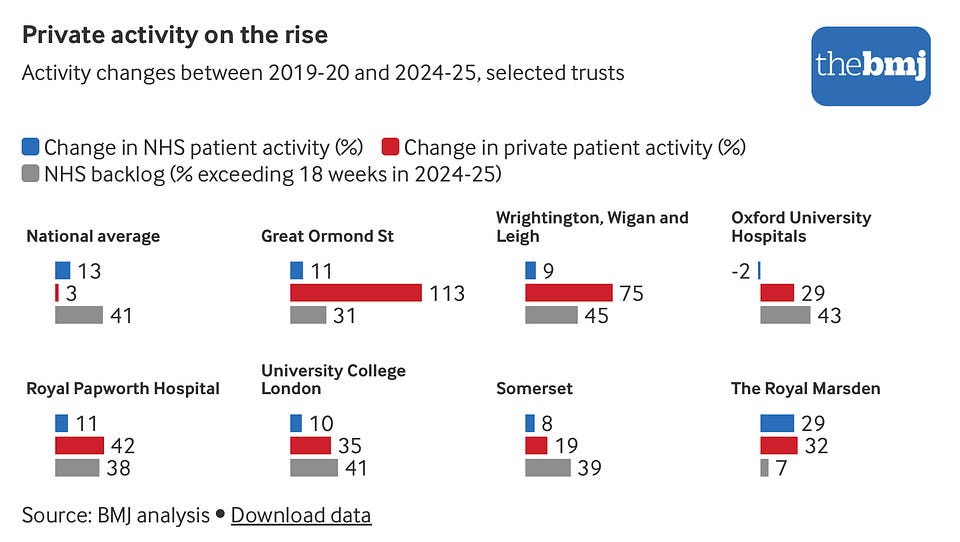
There a number of issues discussed during elections - pot holes, social housing, foreign policy and domestic security. However, no issue is bigger than the National Health Service.
The NHS is part of the tapestry of British culture and society. It encapsulates a war-time sentiment that wanted to look after its most vulnerable and despite its challenges, it is one of the most robust organisations in the world. Privatisation is a word that is on the lips of many. It’s founded on concern and genuine fear that a deteriorating NHS represent several steps backwards.
At its core, the NHS is still a tax-funded system. The overwhelming majority of an NHS trust’s income comes from providing services commissioned by public bodies—primarily Integrated Care Boards and NHS England. In some trusts, this accounts for around 90% of total income.
In simple terms: trusts are paid to treat patients. The more activity they deliver (operations, diagnostics, outpatient care), the more income they receive through national tariff systems and contracts.
But that’s only part of the story….
The Rise of Commercial Income
Over the past decade especially under austerity, trusts have been encouraged to behave more like businesses. They have been asked to diversify their income through a variety of commercial ventures.
Why? Because public funding has been tight. Generating additional income is now seen as a way to maintain services without relying solely on government budgets. Makes sense in the context of austerity I guess.
This has led to a quiet expansion of non-NHS income streams, including:
- Private patient services (paying patients treated within NHS hospitals)
- International work and partnerships
- Diagnostics, labs, and pharmacy services
- Car parking, catering, accommodation, and retail
- Intellectual property and commercial ventures
Some trusts are now earning substantial sums this way and research has that certain hospitals generate 12–53% of their income from commercial activities. That Costa coffee you buy in some way supports the NHS.
Legally, since the Health and Social Care Act 2012, foundation trusts can earn up to 49% of their income from private patients which is a significant shift from earlier restrictions.
Now think about it. If commercial relationships can bring significantly more finance to a Trust that is measured on its financial metrics - why wouldn’t you try and secure more such relationships?
The ethical tension: survival vs mission
So some would argue that one has to be pragmatic. If trusts can bring in extra revenue without reducing NHS care why not? A new M&S or Costa doesn’t hurt anyone.

Broadly speaking, commercialisation changes behaviour. Evidence suggests NHS organisations are becoming more “entrepreneurial,” actively seeking new revenue streams as funding pressures intensify . That raises uncomfortable questions:
- Do hospitals prioritise services that generate income?
- Are wealthier areas better positioned to benefit from private income streams?
- Does this create a two-tier system within the NHS itself?
Indeed, private income is unevenly distributed and therefore, trusts serving more deprived populations tend to earn less from private patients.
Alongside trusts generating their own income, the NHS is also increasingly buying services from private providers.
Recent reporting highlights that:
- Private firms made £1.6 billion in profit from NHS contracts (2023–2025)
- Outsourcing diagnostics (like X-rays) has surged due to staffing shortages
- Some sectors, like eye care, are generating very high profit margins for private providers
Interestingly, this creates a feedback loop. NOT negative feedback I hasten to add.
Underfunding → outsourcing → private sector growth → further dependence.
So… is the NHS being privatised?
That depends on how you define “privatisation.”
- Not quite: The NHS is still publicly funded, free at the point of use, and most care is delivered by public providers.
- But also, not entirely no: The system is increasingly marketised, with trusts behaving more like hybrid public–commercial organisations and private firms embedded in service delivery.
What’s emerging is less a sudden sell-off and more a gradual shift in incentives.
Trusts are no longer just providers of care, they are also income generators, navigating financial survival in a constrained system.
The uncomfortable truth is that commercialisation isn’t necessarily a policy accident. It may be a structural response to chronic underfunding.
The real question isn’t whether the NHS is being privatised overnight. It’s whether, step by step, financial pressure is reshaping what the NHS is and what it’s for.
Originally published on Substack.


